Archive for the ‘Training’ Category

Looking after the triangle?

September 9, 2012

Skyscraper workers

He was a really great sales rep working for Guinness out of their Cork office. He had been in the job for a number of years, was very efficient, very intelligent, very successful and was quite popular with his customers.

He was a great asset to the company with his knowledge of the local area, which was a big deal to Guinness as it was very competitive with both Murphy Brewery and Beamish and Crawford located in the city. In his role he would have had a lot of liaison with the various brand teams in Guinness.

This was probably the most competitive patch for Guinness in all of the country. The sales structure in Guinness consisted of sales reps, there were nine regional managers, three divisional managers with an overall Commercial sales director.

As he was highly rated a lot of pressure was being put on him to look for a promotion and move up the corporate ladder. Any promotion would have probably meant a change of location. To most of the team this promotion opportunity, with more seniority, more perks and a bigger pay packet would have been a godsend – our guy had no interest, he was happy in Cork and loved what he was doing.

When this rep’s name came up in conversation in management circles there was always a sense of a “black mark” and a little cloud of disappointment against him because he wasn’t seen as being ambitious enough.

My Triangle Theory!

Triangle Theory

At the widest point of the triangle there are lots of workers. Some of these are ambitious and push themselves up the triangle into more senior jobs with more responsibility.

Above them are even more senior managers and the business owners – at the very top of the triangle there are a select few who earn the big money, are adept at corporate politics and can handle the responsibility and pressure at this level.

Often these guys and gals will have sold themselves for the job, made the big personal sacrifices, possibly relocating themselves and their families and made work their ultimate priority.

For the triangle to work best we need satisfied, happy people at each level – for those who want to push upwards there are opportunities and for those who are happy with their lot they can stay doing what they hopefully enjoy doing.

Isn’t it better having lots of happy sales reps than a bunch of unhappy sales managers?

Sometimes you have to let the Triangle look after itself …

Greg Canty is a partner of Fuzion

Fuzion are a Marketing & PR firm with offices in Cork and Dublin

Social Media – End of the Auto-Post?

July 2, 2012
Social Media Training - LinkedIn

How often do you post an update on LinkedIn? – thought so !

Over the last few days you may have noticed a message from LinkedIn advising that your “tweets” will no longer appear automatically as status updates on LinkedIn.

If you didn’t have this feature switched on it obviously makes  no difference to you but if you did you need to consider how this affects your social media activity.

Twitter to LinkedIn

I’m not sure what is behind this change but I am suspecting that LinkedIn may want you to post directly from their platform – at least this way you will have to open up your LinkedIn dashboard to make a post and hopefully (for them) notice some adverts that are of interest to you. Clicking these makes them money by the way!

The big problem that I see here is that most people do not consume their social media from LinkedIn – yep, we connect, search for contacts but very very few of us are actually consuming – am I wrong? Is this their effort to make themselves part of the conversation and more relevant?

LinkedIn to Twitter

You can see from the graphic above that it is still possible to push your LinkedIn posts to Twitter once you click the little twitter box at the bottom of the post.

Twitter to Facebook

Another recent development I have noticed is that my Twitter posts are no longer being pushed to Facebook  despite all the connections being switched on. I have disconnected and refreshed the connection but it has made no difference.

I am starting to think that Facebook like LinkedIn want the user to log on directly to their platform to post updates, again in the hope that you will spot some adverts and make them a few bob!

Facebook to Twitter

I’m not sure if it is a coincidence but in line with this lapse in functionality Facebook are promoting their auto posts to Twitter feature quite actively when you log on. Hmmm ..

Robot Using a Computer!

Automation isn’t always good ..

Consequence?

So what does all of this mean to the heavy social media user who is quite active on all platforms and was enjoying the benefit of these time saving applications. Effectively you could post once on Twitter and this post would replicate on both Facebook and LinkedIn. This is what I was doing myself.

Maybe it’s a good thing?

I think you should embrace the change and treat it as a good thing.

Auto posts from Twitter were never the best idea for a number of reasons:

  • You can allow yourself to post more often and repeat posts on Twitter (this frequency could come across as “spam” on Facebook and LinkedIn)
  • If you have posts of a visual nature you are better going to Facebook and posting there directly – when you post from Twitter any link was just appearing as a link.
  • The platforms are quite different and while auto-post can be ok most of the time, often your “tweet” may be inappropriate on LinkedIn and maybe on Facebook
  • I find that if you use the “auto-post” feature you actually start to miss some of the action on the other platforms – they all do a different job for you, don’t forget that.
  • Users of LinkedIn and Facebook may not get all of the @gregcantyfuzion and the hash tag #FF, #Positivity “stuff” and can find it quite annoying and distracting from the actual message

My best advice is to treat each of the social media platforms differently, post separately as appropriate and for ultimate control use tools like Tweetdeck or Hootsuite as time saving devices. Using these you can select the destination for each of your updates (be it to any of your twitter accounts, your facebook personal or business pages).

The schedule facility on these platforms is an extra bonus, which can also be very handy.

LinkedIn

Regarding LinkedIn status updates I don’t see the change making the platform more relevant – If anything it could actually have the opposite effect!

If you wish to make an impact here try:

  • Participating in discussions on Groups you have joined
  • Start discussions in Groups you have joined
  • Start Asking and Answering Questions that have been posted for your industry sector/area of expertise

But I don’t have the time .. (this must be the one thing I hear most from people about social media)

Heh, that’s not my problem …if you have figured out that social media is good for your business then you’ll make the time!

Happy Posting ..

Greg Canty is a partner of Fuzion PR

Note:

If you need a helping hand with your social media effectiveness check out our Social Media Training / Social Media Consultancy services.

Facebook Business Page Changes – March 2012

March 23, 2012

We thought we should put out a blog post dedicated to Facebook seeing as it has been going through a few major changes that will affect everyone that has a Facebook business page.

If you haven’t embraced the changes they are due to be imposed on you on the  31st March.

With over 1.8 million people using Facebook in Ireland we would suggest that every business should be being proactive about the platform. In this article we will take you through some of the business page changes and the impact of these.

We will also discuss the running of competitions and how to generate more interest  in your page.

The biggest change of all will be the new Facebook philosophy – since  the Initial Public Offering in February 2012 Facebook will now be under pressure to deliver financially for its investors.

We will see the platform becoming more and more monetised and we predict that many of the tricks and gimmicks that we have all been using to boost our page fan numbers will be outlawed and in future if you want to do this you will have to advertise – pure and simple.

Facebook need to start delivering for their investors and will have to manage the balance between maintaining a credible and enjoyable social platform and a place where advertising will be pushed more on all of us.

This change of dynamic will affect how we use Facebook and the March changes are the first big hint of this.

Business Page Changes

The whole look and feel of your Facebook business page (personal profile pages have already changed) will change totally on the 31st March and some of your previous features will not work any longer.

You will need to do a few things to maximise the opportunities here. Besides some new visual changes a timeline has also been introduced where at a glance you can view a chronological history of posts on the page.

Our view is that these changes if embraced properly will deliver an even more impactful page for your business.

(For those of you operating your business from a personal page we would advise changing over immediately as this is not allowed – it is possible to convert from one to the other with friends coming across as fans).

Visual

Your own key visual identity will be delivered by two key visuals.

A (see image above) – Thumbnail

Your thumbnail will more than likely be your company logo and this appears on the bottom left of the main image that a viewer will see on your page. This should be 180 x 180 pixels in size.

Every time the page owner makes a post this thumbnail will appear alongside the post.

B (see image above) – Cover

The main banner image is a new feature introduced by Facebook. It is referred to as a “cover” and it stretches above the thumbnail across the page. This image can be a maximum of 851 pixels wide by 315 pixels high.

Facebook have very specific rules about the content of the “cover page”.

It should be an image that captures the business as best as possible but must not include offers, contact details, web address or any “like” us text. The basic logic here is that this information is available elsewhere on the Facebook page.
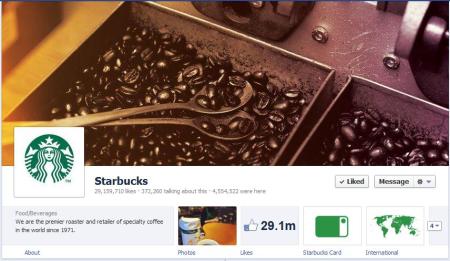
Starbucks on Facebook

It is clear that the new rules prevent the business from advertising or encouraging the user to “like” the page on this cover page.

Our design team are currently preparing new cover pages for a number of clients.

This is a really good opportunity to make your page stand out from competitor pages – grab it!

Landing Page

Before it was possible to specify a “landing page” (see example below) that a new user on your business page was directed to when they first visited.

This was often a customised and highly visual promotional landing page, which encouraged likes, promoted the business or offered the user the opportunity to enter competitions.

Facebook landing pages

This is not possible now using the new layouts and these customised landing pages will be redundant. It is still possible to have a tab that will host competitions and promotions but you can no longer dictate that a user of the page will “land” on this page.

Menu tabs

The menu tabs that were available on the old format on the left hand side of the page are now displayed as tabs in the main display just below (see Starbucks example above) the new cover visual.

It is only possible to display four tabs across the page. The other tabs/applications are available from the right of these displayed tabs by selecting the “down arrow”.

At any time it is only possible to display a maximum of 12 tabs/applications. It is possible to select your own choice of tabs to display on the main page except for photos, which will always display first.

You can do this by clicking on the “down arrow” which will display all the tabs. From here you can swap between tabs that you wish are displayed in the main view.

Posting

You can post as normal but there are a few new features.


Pinning a post – It is now possible to pin a post, which effectively means it will be featured and stay at the top of the page for 7 days.

Other subsequent posts will appear below this post in the stream. This is done by selecting the “pin to top” option (see visual above) that is available to you at the top right corner of each post. You would use this to position your most important post at the top of a page for each new visitor to see first.

Star post – when you “star” a post it will stretch across the full display instead of appearing on the left as a normal post. This will give that post more prominence on the page and it is very useful if you have posts with a lot of content.

Hide/delete post – it is now possible to hide a post (& unhide after if required). When you hide a post it will still display in the  “activity log” as a post. As before it is also possible to permanently delete a post.

Change date of post – it is possible to alter the date of a post so that it will appear in a different position on your timeline.

Milestone – it is now possible to create a “milestone” post, which is a way of marking special events in the life of the business such as a product launch or key event. This feature allows you to upload a photo and specific the milestone date.

Personal User view

The display of your business page is totally customised for each user.

MadMen on facebook
When a user visits a business page their own friend’s activity with that page will appear on the right hand side (see Mad Men visual above) making their experience with the page more informed and personal.

Display View

A user can view different aspects of the business page by choosing from the menu that appears at the top of the page once you start (see image below) scrolling down.


From here the user can choose from the menu of Apps/tabs, choose from the timeline or select different types of highlights.

The timeline can also be accessed directly from the time bar on the right hand side of the page.

Messages

The messages facility is new to Facebook business pages and is a very significant development. Fans of the page can now send a “message” to the page directly if they want to communicate as an alternative to posting directly on the page (which would be visible to all users).

These messages can be viewed and responded to in/from theadmin panel (top of your page). It is possible to shut off this feature preventing fans of the page to send messages.

It is really important that messages are responded to promptly.

Other Features

There are a few new features worth mentioning.

Approval of Posts – it is possible that you can change the settings so that all posts require approval before appearing as posts on the page (this feature can be accessed by going to the  Admin Panel, choosing Manage Page tab, Edit Page, Manage Permissions menu)

Activity Log – from the admin panel it is possible to access a log of all posts by type

Insights – there is now more data available to track the success of your activities

Competitions

This is now a very tricky area for every business who has been building numbers of fans on their page by offering prizes.

The facebook guidelines are quite strict and the new format, which cuts out landing pages where businesses have typically hosted competitions will make it even more difficult.

If you want to run a compeition you will need to:

  • Host it on an app/separate canvas page
  • State clearly that it is not endorsed by Facebook
  • Ensure that the entry criteria does not involve a Facebook activity such as “liking”,”sharing” or “commenting” – for example it could involve answering a question
  • Ask each entrant to give seperate contact details
  • Inform the winner independently of Facebook (by email or phone)
  • Only announce the winner on Facebook once they have been informed and have given their permission

Rozanne Stevens Cookery School
The competition can be mentioned on the wall of the page but cannot be featured on the page.

It would be an idea to mention the competition in a post and then to pin the post to the top of the page, keeping it there above other posts for at least 7 days.

Winning on Facebook

So – with all of these restrictions how can you build your numbers on your Facebook business page and really start engaging with fans?

Facebook Like Button
Content, content, content is the answer…

Without any big fancy tricks or gimmicks you need to give fans good reasons for coming onto your page.

Maybe it will be ..

Because they like you and like what you say

Because they are the first to learn about new products, events and sales?

Because you ask for their opinion and they enjoy giving it

Because you say really interesting things that they enjoy

Because they learn things from your page

Because you give good advice, provide useful tips and information

Because you are really funny and cheer them up

Because you run good competitions and promotions

Because you operate a really great business and they want to express their thanks – a live testimonial!

Because there are really useful Apps on the page

Because they want to feel part of something special

Its important that you achieve all of this through regular posts that are varied, visually interesting and not at all “spam like”.

Over 29.2 million people “like” the Starbucks business page – that’s a lot of coffee drinkers!

“Like” – If you want to boost your page numbers think of this simple word!

While we are having this conversation why not Like the Fuzion Facebook page – we need to catch up with Starbucks!

Social Media Training

If you require assistance with your Facebook activity or any other aspect of your Social Media presence including your overall strategy, blogging, Twitter or LinkedIn use please give us a call.

Fuzion provide Social Media Consultancy, one to one training and run courses for various organisations incuding the Enterprise Boards and the Digital Marketing Institute.

Your 31st March to-do list

We have mentioned a lot of issues and changes but the main things that you need to concern yourself with for the 31st March are:

  • Maximise your visual opportunity through a customised cover age (851 x 315 pixels)
  • Decide on the tabs that you wish are displayed on the main page
  • Review your settings that allow visitors to post
  • Decide if you wish to allow fans to leave messages

Until next time.. keep liking !!

Greg Canty is a partner of Fuzion

The Business Social Media Dilemma

May 2, 2011
Gary Vaynerchuk - Thank You Economy

Gary signing copies of Thank You Economy

In the terrific Smarter Egg book learning programme our group has just finished reading and discussing the excellent book by Gary Vaynerchuk, “The Thank You Economy” , which deals broadly with businesses adopting a “Thank You” philosophy and embracing the Social Media opportunity properly to be successful in the marketplace.

The book was really interesting but in it Gary V took a huge swipe at PR companies for their approach to Social Media for their clients, which was a little unfair (then again, it depends on your PR company!).

Basically he stated that 90% of the worst social media engagements were produced by PR companies! Even stronger than that he accused PR companies of spotting that the “wind” was blowing away from them towards social media and the reason they are engaging with clients in this area is just to bolster up their fees and chargeable hours.

In my experience Gary is way off the mark but it does put the spotlight on what I refer to as the “Social Media Dilemma“.

Social Media Dilemma

It goes like this – as a PR company who always takes a broad “holistic” approach to communications we know and clearly understand the benefit of Social Media for our clients, in fact in 99% of cases well before them. We push for them to engage in this area properly but we do realise that the “voice” used on the platforms should be a trusted and skilled internal voice.

Now for the dilemma – often this trusted and skilled voice is not available and our client is not prepared to allocate the proper resource to this area.

To make sure that they do not get left behind their competitors we will make ensure that our client’s open up their Social Media platforms (Facebook, Twitter, LinkedIn, Youtube and their blog), that they look the part as they are an extension of their brand online and we will also provide them with the necessary training so that they are well equipped to use them proficiently.

We know we cannot do this for them but we will always be there to support them and will never be shy in recommending that they should be more active in that space. Sometimes as an option we might assist them in the “learning phase” until they are fully up and running. (often we have to be quite careful with Social Media conversations because if a client isn’t ready to listen you will end up annoying them!)

We see the huge opportunity for clients and if the Social Media platforms were not there we would be gutted – they add so much opportunity for all our clients.

Swiss Watchmaker

Master Craftsman

Dilemma: Who? – Social Media Manager

Who looks after the Social Media in a business is a vital issue. Gary V refers to this person as the “Community Manager” and is quite right in stating that it should not be someone that you can’t find anything else to do with!

He rightly suggests that this person should not be an intern or another junior person. It should be someone who knows the business intimately, who understands the customer, who is passionate about customer service and who is well able to communicate in the “social media” arena – this person must be quite skilled in this area, which is often underestimated.

Why Social Media activity fails?

This leads me to Gary’s suggestions as to why most Social Media initiatives fail:

1. Using tactics instead of strategy

2. Using it to exclusively put out fires

3. Using it to brag

4. Using it as a press release

5. Exclusively re-tweeting other people’s material rather than generating “own” content

6. Using it to push product

7. Expecting immediate results

I agree with Gary on all of these points 100% but I think it is missing a BIG, BIG last point – a NUMBER 8!

8. Skill

This for me is probably the biggest point and while Gary alludes to it at times I think he actually doesn’t fully appreciate it and maybe he takes his own talent in this area for granted.

Using social media is a very highly skilled discipline, which requires individuals:

  • who understand each of the media intimately
  • who have strong “informal writing” ability
  • who understand the business and customers well
  • who can be fully trusted to be the voice of the company,
  • who have enquiring minds
  • who can manage the unstructured nature of the communications
  • who can respond themselves under most circumstances but knowing when they need assistance
  • who can spot and manage communications with genuine customers and at the same time filter out posts by possible competitors/cranks
  • who have the ability to summarise and relate issues back to management in a timely fashion.

To add to this the platforms have to be managed 24/7, which requires some co-ordination of resources, consistency and dedication.

Wow – that is some job!

Gary Vaynerchuk is a social media genius who is the passionate owner of his own wine business, which makes him quite unique – maybe he underestimates his ability in this area and as a result thinks it is easy for anyone to just jump in and be an expert.

So Gary, thanks for the book, thanks for the terrific examples (Old Spice and the San Francisco dentist!) and insights, never underestimate your own skills and please don’t be too hard on the poor PR companies in the future!

Fuzion provide Social Media Consultancy and Social Media Training.

Greg Canty is a partner of Fuzion

Are you spending enough on Positive Costs?

April 25, 2011
Doorman

Positive Cost ?

In my accounting days (yes, I know most of you won’t believe it – I was!!) we had a few different ways of looking at the costs of a business.

The most popular of these was a very simple analysis – Fixed Costs, which were those costs that would not vary with volume and Variable Costs, which were the costs which did vary according to volume. This was quite a simplistic model, which didn’t always hold up!

We then had other methods of looking at costs such as Zero Base Costing and Activity Based Costing .. interesting stuff indeed!

Since the recession has kicked in I have witnessed first hand clients being advised to cut back on expenses by the accounting fraternity and often they just do it themselves automatically – the types of costs that get chopped first are those that are deemed to be “unnecessary”, which will typically include marketing &  advertising spend, sales reps, items like training, corporate entertainment, Christmas gifts, staff entertainment  and other “extras”.

On the surface it is easy to figure out why companies would cut back in such a way but you could ask the question: Why spend this money when sales were easier to come by and when it is harder to win business you just abandon them?

Could reduced sales be a self fulfilling prophecy when you cut out certain overheads?

The New Cost Model

Taking the knowledge of my old profession and combining this with what I am witnessing with clients every day I am now proposing a new way of analysing costs.

Here goes ..

There are actually three types of costs:

Negative Costs –   these are the costs that a business is “stuck” with, regardless of volume. It would include Rent and Rates (but not necessarily 100% of these – I will explain that later), Insurance, ESB, etc.

Maintenance Costs – these are the costs of servicing the business that you have brought in. It would such items as staff costs, raw materials, power and delivery costs.

Positive Costs – these are the costs that are all about bringing new business in, effectively the costs, which should have a “positive effect” on the business.

Positive costs are the most important costs of the whole business, they are the elements that are designed to start the engine, the elements that can make things happen, that “trigger” customers to actually place an order.

Positive costs are far reaching and could include surprise elements that you would not expect: the premium you pay to have a premises in a location that will bring in more customers, the cost of washing the car after it has been serviced, the cost of polishing the shoes that have been repaired, the cost of having a receptionist who answers calls promptly and deals with customer queries swiftly.

There could be an element of positive costs to most people overhead in the business – the porter who does “meet and greet” at the door of the hotel, the credit controller who carefully spends time with customers who are experiencing difficulty, the accountant who spends time with customers to understand the business better, the staff party to reward a hard working team and a deliberate initiative to improve morale.

I’m sure with a little effort you will think of thousands of other unexpected examples – all of these elements contribute to bringing in more business and create a “positive effect” on the business.

Of course Positive Costs will include items such as advertising, marketing, graphic design, web marketing, social media activity and even PR!

Positive costs are absolutely essential for generating business for any company – cutting these out may be viewed as a necessary step but it will eventually choke the oxygen of the business.

Recession (or any time for that matter)

Using our new cost model I would suggest the following approach:

Analyse your costs into the different cost categories and work towards –

1. Reducing the negative costs as much as possible

2. Improving efficiencies and work practices so that maintenance costs are as little as possible

3. Spending as much of your overhead budget as possible on positive costs .

I am not for one minute suggesting naive spending – always look for the best value in your positive costs and don’t waste money, making sure they are actually positive costs – that the spend results in increases in business.

Are you spending enough on Positive Costs in your business?

Greg Canty is a partner of Fuzion

Motivating the boss!

March 2, 2011
Give your boss a hug!

Give your boss a hug!

I was working on employee contracts lately, which I really hate because you get into this formal, “what happens when things go wrong” world.

You suddenly go from the niceties of the interview and the informal job offer to the “legal contract“, which at the end of the day is a vital legal document protecting you and your staff members in the event of any issues arising.

I know it has to be written in a particular way but I really try and keep it as “real” as possible capturing the essence of the agreement and the spirit of the working arrangement and our organisation. Even with our very best efforts the contracts still carry some of those awful formal bits.

Before I put the latest offer in the post I have one last glance over it and I realise that I have left something out that is really vital to me, I have actually quite carelessly left it out of all the contracts I have ever issued.

Here goes with the missing clause – In the course of your duties you must motivate the boss!

I can’t ever recall seeing something like this in an employee contract and I’m sure it would be a difficult issue to review if there were ever an issue or dispute but I do think it would be a great thing to put in there.

Like most bosses today I am juggling a million things and so many different roles. I work really hard, I try to make sure our team are motivated and happy (despite tax increases reducing their income), I make sure that our working conditions are comfortable, I make sure we stay up to date on all the latest trends and technology, I make sure that we bring in enough business to pay the bills, I make sure that we collect on time (or as best as possible) from our clients, I make sure that we pay our bills, I make sure that we pay our taxes and most of all I make sure that we deliver the magic that makes all of this happens; satisfied clients – we make sure together that we consistently deliver great results for them.

I don’t expect a medal or anything for the really long hours, effort, endurance and 24/7 focus but at times this can be really stressful and quite exhausting, particularly now when the rewards can be as simple as just staying in business, which I do fully appreciate. While I am normally really upbeat and will gladly take on the role of motivating the others at times I do slump a little – it’s at these times that I really need one of my crew to spot the “dip” and say those few words, give me a motivational pep talk, take me for a coffee or whatever it takes.

Thankfully my crew are good at spotting the dip and aren’t shy at offering a “lift” at the right time – that is one of the most valuable things they could do for me. Probably more valuable that all the other stuff that is required of them – After all there is no jurisdiction or hierarchy over motivation.

How about putting that clause in the contracts? Not so crazy after all ..

Greg Canty is a partner of Fuzion Communications.

Whoah – Major changes to Facebook “pages”

February 15, 2011
Facebook changes to business pages

Changes to Facebook - confused?

Just when we were getting used to Facebook they go and change it all again!

This round of changes are quite significant and represent a major change in how they are thinking including (I think?) trying to incorporate things that are possible on Twitter (a business following a business) and a facility whereby businesses can align to each other.

I’ll do my best to explain some of the changes .. here goes

Look and Feel

The look and feel of Business Pages has changed on Facebook with some of the buttons/tabs switching position. The profile pic (if you were utilising its full capability) will now be reduced – from 200 pixels wide and 600 long to 180 x 540 – a call to your graphic designer may be required.

Similar to the new personal profile pages the new business page will also display photos of your most recent “experiences” on the top of the page.

You now have the ability (and choice) to display the “admins” for the page (below the profile pic).

Users switching to Pages

This is a major change and one I suspect is being influenced by twitter to an extent. Now a user can “switch” their profile to their page (or page of your choice if you are admin for a few pages) and then behave more like an individual – however in this mode the user does not have the full functionality as if you would with a personal profile but you can now:

  • Like other pages (you cannot be friends with individuals)
  • Like and Comment on other pages as “the business”

In this way you will start to see a community of businesses “liking” each other – something which you can do easily on twitter in a very uncomplicated way.

Facebook changes

Recommended pages appears to the right of your page

To enhance this feature Facebook recommends pages for your business page to like (as opposed to friends) based on similar people “likes” and interests on your business page and theirs (you will have to read that sentence a few times to grasp the point I suspect!!).

One of the effects of this is that updates on business pages you choose to like will come into your news feed (using Facebook as a business “page” user), which in a way can bring you specific information about pages only. This feature enables you to engage with the latest and important news from other business Pages you like.

Information about Business “Page” updates

Facebook has introduced a facility whereby you can get alerts for activity on your page. If you have a large volume of activity this will drive you nuts, however it will help to make sure you don’t miss any important activity of your business pages.

Relevancy – The “everyone” filter

The “Everyone” filter on the Wall by selection provides a new way for people to see the most interesting posts first.

Enhanced Moderations

Facebook have provided more facilities for moderating content on your page automatically including posts by users above a certain age and you also have the ability to block posts using certain selected  “keywords”.

More changes

The changes being implemented are still a little “buggy” so expect a few glitches and a few more things to change slightly – no throwing the computer out the window guys … it’s not worth it!!

All in all you can see that Facebook is trying to enhance the “business” aspects of the platform, which provides opportunities for anyone in business who is clever enough to fully utilise them.

Sorry about the heavy post ..

Fuzion provide a full Social Media Consultancy service.

Greg Canty is a partner of Fuzion Communications

£35 a week!

December 31, 2010

Greg Afro Canty

September 1982 and this 17 year old hopped off the bus (this was unusual because every other time that  I went to work it was on my trusted bicycle – then again it was day one of the rest of my life!) on The Grand Parade in Cork and headed to work for the first time to Barber & O’Leary, Financial and Management Consultants, on the South Mall no less!

To celebrate this special occasion I had a new brown blazer with a choice of different trousers, each a different shade of brown or beige to complete this classic ensemble. The “piece de resistance” was my curly afro, while quite unique was probably a talking point for many!

Despite the grand title the firm was really a small to medium sized accountancy and audit firm, but the partners did have some investments in their own projects, which we all ended up working on at some point.

While I was confident I could make my mark on the business world, I was also quite nervous – I didn’t even do accountancy in secondary school!

Jumping right in at the deep end, that September I started 5 fabulous years working by day and studying for my accountancy exams by night. We dealt with clients of all sorts, big and small including my favourite, Mrs O’Sullivan who had a right skip in her step after her beloved husband passed away .. The glamour of her all of a sudden!

The amazing thing with accountancy (a profession often mocked quite unfairly) is that immediately because you are dealing with peoples finances and their “financial stories” (I always had a romantic viewpoint that the accountant is actually a financial storyteller), you are taken into a position of trust, even at the age of 17!  This is a privileged position to be in, considering that employees could be working in that business all their lives and never be in that position of trust and influence that the young accountant can often find themselves. Wow, I absolutely loved it.

Many people assumed that I must have loved working with numbers and that is why I did accountancy .. Nah , I loved the idea of being in business and I reckoned this was going to be the best business degree of all – day in day out we worked on all sorts of clients, doing bank reconciliations, sorting out total messes at times, preparing accounts (storytelling, I tell you) listening, learning and advising.

My god, I learned so much from one of the partners of the firm, the fabulous James Barber, who was an absolutely brilliant boss (I would love to catch up with him some time and find out what he really made of the curly haired 17 year old!) and I tried my best to avoid the other partner , the unpredictable Sean O’Leary, who mostly didn’t seem to care at all and the odd time took too much interest.

The crew inside there were great but I must admit I learned the most from the enigmatic Christopher “third degree” Burns who was an erratic but brilliant accountant, a chancer most of the time but the only one in my view who could handle our biggest bully of a client Mr B (unfair to name the man but he shares a surname with my mums side of the family – maybe we are related? Scary thought.. ). I still tell people stories about Third Degree to this day – a total and very colourful legend!

Robert Arnopp from Bandon, shared the same love of music as me and we swapped albums continuously throughout this time. I later met one of my best buddies Brian Sexton, who joined the year after me and later worked with me again in the drinks industry. Brian famously noticed the very attractive secretary, Bernadette Dilworth on his first day at work (“cop on Brian” she is out of our league were my clear thoughts) and ended up marrying her years later! For some reason Brian and I started to call each other “Bob”, which  we still do to this day. Why? I have no idea .. We managed to have some of the best of laughs out on different jobs that we worked on together – we were just kids, behaving as professionally as possible, but at times we just couldn’t control the giggles!

These were my formative years, I worked hard and studied hard, I learned incredible skills that have always stayed with me and I ended up leaving the practice five years later as a young qualified accountant. I was asked to stay on but I needed to discover more about the world of business!

I started at £35 a week, just like any other apprentice (I was making more than this on my newspaper round, which I continued out of necessity!) and genuinely loved every minute of it except for the 3 months we did the most boring study in the whole world for the Cork Harbour Commissioners, which was one of those times I wished Sean O’Leary would take less interest!

Regarding our huge pay packets, Robert had this great story of going to the bank and lodging his monthly pay check. He knew the bank teller who commented on how much he was being paid, very impressive indeed. He didn’t have the heart to tell her it was a months pay and not a weeks!

To Mr Barber, Third Degree Burns, Robert and Brian thanks for the fabulous business degree, which always stands to me and to be honest, the really great time!

Greg Canty is a partner of Fuzion Communications

But you have no experience ..

December 20, 2010
Fuzion Christmas Card

Fuzion Christmas Card - Paul Wade

On the 1st October a really bright young aspiring Graphic Designer called into Fuzion to show us his portfolio. This followed a very courteous email about wanting some work experience at no charge.

The situation is really simple – Paul Wade a recent graduate of CIT, the Design & Communications course, like so many other graduates has no practical work experience. He is looking for a job and of course …. he has no experience!

Instead of this being an obstacle he simply removed the problem by asking us to take him on for free in exchange for “experience” – he has been working and learning under Graham our Senior Designer for the last two months. As he says himself, he has learnt more in these two months than he had in his few years at college.

The one thing we can’t teach him is something he had already in bucket loads – a great can-do positive attitude.

The other thing about Paul is that he also has a job in a local supermarket, which pays his bills.

As soon as the workload permits we would like to take him on here – why? He has a great attitude, he is a nice guy, he has integrated with our team and he has learned a lot.

By the way – the Fuzion Christmas card you can see on this blog – that’s Paul’s work!

Well done Paul for making it happen!

Greg Canty is a partner of Fuzion Communications