Archive for the ‘Accounting’ Category

Today I was an Accountant

October 17, 2013

accountant

I can’t help it ….I was once an accountant!

To be fair most people who meet me now get puzzled by this.

“Really?” ….yep!

For some reason I still won’t delegate these duties and in October of each year those deadline walls come closing in and there is no choice other than to knuckle down and prepare the accounts for the annual tax return.

I was like a bear today (sincere apologies to everyone concerned!) – I had worked till midnight last night doing the bank reconciliation and I was determined to break the back on the rest of the accounts work today. Besides feeling tired it made me feel totally miserable – the thought of the best part of my day being spent on “negative” work was killing me.

Romantically I always reckoned that doing the accounts was like telling the story of the business for the year. A long time ago I made a choice that I wanted to be part of the story rather than telling it afterwards!

Instead of meeting clients, trying to make positive things happen I had to, “for one day only” focus on just getting this horrible task done – I needed to be an accountant again and a cloud descended around me.

As planned I have broken the back on the accounts and while it wasn’t quite as bad a day as I had feared I am looking forward to being the “other me” tomorrow.

Are you telling the story or are you part of the story?

Greg Canty is a partner of Fuzion

Fuzion are an Irish Marketing, PR and Graphic Design agency with offices in Cork and Dublin

Driving too hard a bargain

August 20, 2013

Super pub

We were thrilled when the biggest super pub in the City called us and invited us to pitch for their business – we must be doing something right I thought.

At the time I was the General Manager of  Deasy’s, a Guinness subsidiary with depots in Cork and West Cork. We were drinks wholesalers and we delivered beer and soft drinks to the pub and off licence trade in these areas.

We had been doing quite well and this pub was one of those “prize” accounts that all our competitors were chasing. The business they were doing would probably be about 20 times the size of a normal pub.

This was an account we wanted so we put a really competitive price list together. There was enough in the price to win the business but still leave enough for us to make it worth our while.

Not good enough – we had to do better.

I guess this was no surprise as the incumbent wasn’t going to lose this business easily and the buyer  (in those days no one had a buyer but this crew had!) was going to quite naturally play us off against each other.

We sharpened the pencils and ate into our margins leaving a little left for us.

Not good enough – we had to do better.

At this stage we cut our margin on products across the board effectively giving them the cheapest prices we were giving anyone – this was crazy but if we wanted this prize account its what we had to do.

The buyer rang our Sales Manager – congratulations, we had won the account and they looked forward to doing business with us. Over time with the introduction of some new products and a few substitute brands we might be able to bring it back to some level profitability.

After our first delivery the buyer rang and told us that he had some breakages left over from his previous supplier that he wanted us to uplift. We would have a look at them and decide what we could do – even with out of date alcoholic products we would be able to reclaim the duty and pass the rebate back to them.

We inspected the breakages and there was a huge quantity of all sorts that he wanted to return – clearly they had done a clear out of their stock room and expected us to take back this rubbish that had been accumulated for years. Many of the products were non-alcoholic and some were brands that we never stocked and would not be able to get credit from anyone.

We carefully assessed the breakages and informed the buyer how much credit we would be able to manage. He informed us in no uncertain terms that he would pull the whole contract if we did not give him a 100% credit at our list prices – he was being totally unreasonable but he was serious.

We reluctantly collected the “rubbish” and processed the credit.

The account continued in this vein – he wanted emergency deliveries at a moments notice whenever he ran short, often at quite unreasonable times.

He pushed us so hard and continued to do so – so much so that there was no win left for us and we were starting to feel quite abused.

All of a sudden it wasn’t our prize account, it was a thorn in our sides. We started to get strict with them – they had to order properly, we cut out emergency deliveries. We maintained a good level of service  but now it was on our terms.

From time to time our suppliers would give us beer fridges and promotional events that we could allocate where we chose – needless to say we never passed these onto our “prize” account.

After six months we got a call from their purchasing manager who wanted to do another round of “squeezing” and was inviting us to submit our best prices.

This time we did a full review of our price list, increased the prices across the board and politely let someone else be a busy fool – that was the last time we set foot in the place.

James Caan - The Real DealIn James Caan’s book “The Real Deal” he spoke about a valuable lesson his dad had taught him from his leather trading days – it was always vital that you made sure there was a “Win-Win” left for both parties in a deal.

In our case there was certainly no win for us and in truth the supplier also lost out – they pushed us to the point where we didn’t actually care about their business any more.

Be careful not to drive “too hard” a bargain and make sure you walk away before the point where the business just isn’t worth it anymore

Greg Canty is a partner of Fuzion

Fuzion are a Marketing, PR and Graphic Design firm in Ireland with offices in Cork and Dublin

Petty Cash and the Red Head

August 18, 2013

Redhead

We were working to a strict budget but we knew we needed another person in the company to cover a few key areas of weakness.

The person would have to be a really organised all rounder who could help with stock control, provide some admin support and take over the credit control function.

It was a big ask finding the right person to do all of this in particular for the budget we were offering.

I was the financial controller of both Deasy & Co in Cork and Connacht Mineral Water Co in Galway, both Guinness subsidiaries.

I was in Galway early in the morning to conduct interviews with John, the General Manager. Both of us were in our early twenties, bursting a gut to drive on our careers but in reality quite inexperienced.

Applicant after applicant came through and we weren’t finding anyone that fitted the bill.

Eventually a really well dressed attractive young woman came through the door for interview. This gorgeous redhead wearing a sharp suit sat down confidently and answered all of our questions with authority.

To be honest she had taken both our breaths away –  in some way I think both of us were willing her to give us the right answers!

As the interview progressed and we were falling further under the spell of this confident, bright young woman I could hear the different voices in my head “just give her the job“, “give her the job now and forget about the other interviews” “be responsible Greg, start probing …

You know the job on offer would involve some credit control?” I asked

I know, that’s no problem” she replied confidently

A lot of people find credit control a difficult thing to do, would you be ok with it?” I probed further

Yes, I would be totally fine with that” she responded but not as assured as earlier.

How would you describe credit control?” my final question

She batted her eyelids, flicked her red hair and smiled at both of us “Would that have something to do with petty cash?

We knew we would both be fired within a month if we gave our attractive redhead the job and eventually we settled for a good solid young lad, who we would have to give some training to, so he could manage all aspects of the job.

The fancy package isn’t always the one that will get the job done!

Greg Canty is a partner of Fuzion

Fuzion are a Marketing, PR and Design firm in Ireland with offices in Cork and Dublin

The Sacred Cow – Raise Corporation Tax?

September 9, 2012
Sacred Cow - Irish Corporation Tax

Dare we ask the question?

I know this is a really unpopular thing to say – is it time to challenge the Sacred Cow and talk about raising the Corporation Tax rate in Ireland?

I think it is possible to do this and structure it in such a way that will still encourage companies to drive on in Ireland.

Before you think poor old Greg has totally lost his marbles hear me out ..

Why we need to look at this?

Let’s face it, people are bleeding and except for this government being prepared to grasp the nettle and take on some of those areas of excess (“real” sacred cows) that they have still left alone, they just can’t hit the regular Irish taxpayer any more – there is nothing left, nothing.

We need people to have some money in their pockets to keep the indigenous Irish economy going – inflicting more pain and extracting more cash from consumers will just do more damage than good. Aren’t we seeing this already?

Increasing the tax rate on companies who are making profits (let’s face it if you are losing money higher taxes won’t effect you) isn’t the worst thing in the world to do. At least they will be able to cope with it.

The Numbers

3.5 billion was collected last year from Corporation Tax at a rate of 12.5%. This was 10.2% of the overall tax take of 34.2 billion.

This 3.5 billion was the lowest collection of Corporation Tax since 1999 when about the same was collected when the CT rate was 28%.

The Challenge

This government must balance the books, they must collect more taxes, reduce expenditure, start generating jobs and begin to spark economic revival.

How can we do this if we scare the pants off prospective foreign investors by increasing the corporation tax rate?

We are led to believe with absolute certainty by those in “the know” that raising the CT rate is a no go area because it will start a mass exodus of these foreign investors.

Are we sure of that? Is this the main reason that is keeping them in Ireland? I’m not sure, but what do I know.

Taxes in Ireland

Big huh?

My Proposal

1. Raise Corporation Tax by 2.5% (hopefully for just a few years)

2. Introduce 100% immediate allowances for capital spend (this was done successfully in Australia)

3. Introduce tax incentives for companies who increase employee numbers.

4. Use 50% of the increase in CT tax as an investment fund for IT education (we are too far behind international standards and will have a serious problem in attracting these companies if we don’t sort out this supply pool of educated staff ) and an investment fund for indigenous Irish companies who need support at this stage to stay alive (only the ones that have a future)

While the CT tax rate would increase, for those companies that invest in capital and increase job numbers they could actually pay even less tax than now.

In a sweep we would collect more tax from those that can afford it, incentivise jobs and investment, invest in IT education and support indigenous Irish businesses. We might also have a bargaining chip in EU negotiations.

And..we would also be able to lay off the general public who are already bleeding way too much.

What do you think?

Ok, what the hell do I know? Maybe my assumptions are wrong, maybe they are too simplistic and maybe my figures are all wrong – maybe all of this is happening already and these incentives are in place?

At least lets have a discussion and flesh out this Sacred Cow before we cripple Joe Public even more without looking at the alternatives.

Is it time?

Greg Canty is a partner of Fuzion (he was an accountant at one point in time!)

Fuzion are a Marketing and PR firm with offices in Dublin and Cork

Big Dreams and Bad Sums

August 5, 2012
Kingsley Hotel

Kingsley Hotel – Under Water?

Driving past the Kingsley Hotel in Cork on the “Straight Road” as the locals call it, it’s really sad to see the place still shut and sadder again to know that it is now in the hands of the Receiver along with it’s sister hotel the Midleton Park.

The Kingsley Hotel was originally opened in 1998 on the site of the old public baths (I used hate going there as a kid!) by Thomas McCarthy and Thomas Kelly, two experienced hoteliers.

Dreaming big and with the help of willing lenders, this business duo transformed the then successful hotel in 2003 into a large five star hotel with over 130 bedrooms, suites and a separate luxury apartment development called The Residence.

We passed the hotel on a regular basis as the major renovation transformed the existing premises, including the building of an underground car park, which caused some costly delays to the project.

The work seemed to take forever and was eventually completed leaving Cork with a superb large capacity five star hotel. We regularly met clients there for meetings and we also had a few Fuzion brainstorming sessions, which invariably ended up being helped along with a few glasses of vino!

My last memory of the hotel was attending a book launch for Brian O’Connell’s fine publication “Wasted” in one of the superb reception rooms.

The freak Cork floods in November 2009 managed to shut the hotel and unlike all the other business properties affected it has remained unopened, apparently due in part to drawn out and complicated disputes over insurance.

Kingsley Hotel bedroom

Big Dreams?

As already mentioned the hotel and it’s sister hotel, which is reported to be trading well have been put into receivership by the bank continuing a trend, which we have witnessed across the length and breadth of the country.

This particular “episode” has been complicated by a freak flood but similar to every other scenario the banks/NAMA have decided that the high level of debt will not be recovered so they move and take over the operation.

Does this course of action and the relavant sums make sense?

Lend too much to a business on the back of silly (hindsight is a great thing!) property values
– The business can’t sustain the high level of debt during the recession
– A depressed property market puts the whole scenario in the red
– Turf out the existing (experienced?) operators and replace them with high fee receivers and management companies
Negotiate a sale at a stupid price (watch this space) to an opportunistic investor (the bargain hunters are queuing up to get the best of the rich pickings)
– Chase the individuals unrealistically for the balance of the debt
– Eventually write off the unnecessarily huge level of unpaid debt (taxpayer mops up the difference)

This is the worst, laziest and most costly solution to a very tricky problem and unfortunately it seems to be the most popular course of action being taken.

With the Kingsley example and so many others that we are witnessing on a regular basis, surely it would be better to let proven operators manage the business through this difficult period in a “realistic” manner and let the economy and the property assets recover over time.

Businessmen with Big Dreams are the lifeblood of our economic recovery and the institutions that let these dreams go too far need to stop doing such Bad Sums..

Let’s dream again by having the courage to do Big Sums.

Greg Canty is a partner of Fuzion

Fuzion are a Marketing and PR firm with offices in Cork and Dublin

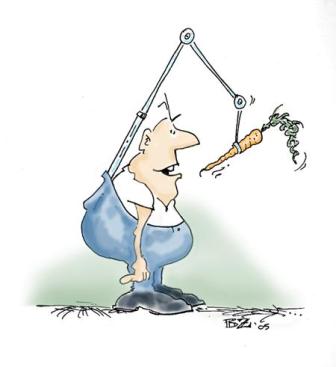
Ignoring the Carrot!

June 27, 2012
Ignoring the Carrot

Ignoring the Carrot

There I sat, new job, GM of quite a large drink’s wholesale company and my new boss, the MD of one of Ireland’s largest drink companies outlined my “objectives” for the year.

Hit these objectives and you got your bonus at the end of the year …simple.

One of these was really unrealistic – he wanted me to raise the Gross Margin % from it’s current level to a higher figure. I explained clearly that this would be impossible as the business volume was shifting from pub products (higher margin) to off licence products (much lower margin) due to lifestyle trends which pretty much everyone in the industry had accepted.

This led to a really lengthy discussion where we both made our case and fought our corner with no real resolution. I explained that the “money” margin on these off licence products could actually be higher and the target should be a money one and not a % one.  At the end of the discussion he insisted that my “target” stood and I quite politely told him that it was impossible.

I left the meeting knowing this target could not be achieved but determined to drive the business forward in the most profitable way possible.

I’m not very happy with your performance, you missed your objective and as a result you won’t be getting your bonus!”  he said to me across the desk, a year later as we had my review. He waited for my reaction, expecting me to fight my case or get all offended.

I know, and I told you that a year ago” I responded “and to be honest I don’t really care about a bonus if it’s based on the wrong criteria. I care about doing a good job” …. silence.

After that , we never really got on too well. I guess it was because I didn’t behave like the others he was used to dealing with and the “Carrot” didn’t matter to me one way or the other.

You don’t always need a carrot to force good work and if you’re making targets for your team make sure they are realistic and they believe in them.

Greg Canty is a partner of Fuzion

Is it all about price?

October 9, 2011
Greg Canty Fuzion

Win Win or crush the seller?

I remember when I started my first accountancy industry job in Deasy & Co. one of the early tasks I had was the job of selecting a supplier for all of our stationery requirements.

In those days we went through huge amounts of paper and our bill would have been quite large.

I approached the task diligently as the good accountant that I was – meeting each of the prospective suppliers and impassionately processing their quotes. The best quote won and next time round I did exactly the same thing all over again and put our business out for tender. It didn’t really matter who the supplier was – as long as I achieved the best price and the maximum savings for the company – wasn’t I brilliant?

24 years later and I find ourselves putting quotes together the whole time to hopefully win business and on the other side of the coin we deal with many suppliers.

A few things have I have learnt about pricing since those early days:

  • The clients who hammer us on price because that’s just what they do, I have very little interest in doing business with them again
  • If every piece of work a prospective client has is put out to auction I find myself caring less about this business (unless it is a tender situation where this is what you have to do)
  • I deal with suppliers that I like dealing with as long as their prices are fair – I won’t break them up every time
  • Trust and respect and a genuine interest in each others business is really important
  • The word Loyalty is really important -not blind loyalty
  • You have to leave a Win Win in every single deal that you do (James Caan the successful businessman from Dragons Den talks about learning this valuable lesson from his Dad at an early stage in his career in his excellent book)

For us building a successful business is all about providing excellent services (we don’t always get it right but we will try our best) to our clients in a partnership capacity – they outline their objectives and we do our best to achieve these together.

In the course of our business we use service and product providers that we trust and like doing business with, that ultimately will help us do our job. There is one exception where one of our suppliers just doesn’t care about our business and we are busy looking for a better solution.

The price should be fair and leave a Win Win for everyone.

Do you pay a heavy price when it’s all about price?

Greg Canty is a partner of Fuzion

p.s. apologies to those suppliers years ago – I guess we were probably the loser ?

Are you spending enough on Positive Costs?

April 25, 2011
Doorman

Positive Cost ?

In my accounting days (yes, I know most of you won’t believe it – I was!!) we had a few different ways of looking at the costs of a business.

The most popular of these was a very simple analysis – Fixed Costs, which were those costs that would not vary with volume and Variable Costs, which were the costs which did vary according to volume. This was quite a simplistic model, which didn’t always hold up!

We then had other methods of looking at costs such as Zero Base Costing and Activity Based Costing .. interesting stuff indeed!

Since the recession has kicked in I have witnessed first hand clients being advised to cut back on expenses by the accounting fraternity and often they just do it themselves automatically – the types of costs that get chopped first are those that are deemed to be “unnecessary”, which will typically include marketing &  advertising spend, sales reps, items like training, corporate entertainment, Christmas gifts, staff entertainment  and other “extras”.

On the surface it is easy to figure out why companies would cut back in such a way but you could ask the question: Why spend this money when sales were easier to come by and when it is harder to win business you just abandon them?

Could reduced sales be a self fulfilling prophecy when you cut out certain overheads?

The New Cost Model

Taking the knowledge of my old profession and combining this with what I am witnessing with clients every day I am now proposing a new way of analysing costs.

Here goes ..

There are actually three types of costs:

Negative Costs –   these are the costs that a business is “stuck” with, regardless of volume. It would include Rent and Rates (but not necessarily 100% of these – I will explain that later), Insurance, ESB, etc.

Maintenance Costs – these are the costs of servicing the business that you have brought in. It would such items as staff costs, raw materials, power and delivery costs.

Positive Costs – these are the costs that are all about bringing new business in, effectively the costs, which should have a “positive effect” on the business.

Positive costs are the most important costs of the whole business, they are the elements that are designed to start the engine, the elements that can make things happen, that “trigger” customers to actually place an order.

Positive costs are far reaching and could include surprise elements that you would not expect: the premium you pay to have a premises in a location that will bring in more customers, the cost of washing the car after it has been serviced, the cost of polishing the shoes that have been repaired, the cost of having a receptionist who answers calls promptly and deals with customer queries swiftly.

There could be an element of positive costs to most people overhead in the business – the porter who does “meet and greet” at the door of the hotel, the credit controller who carefully spends time with customers who are experiencing difficulty, the accountant who spends time with customers to understand the business better, the staff party to reward a hard working team and a deliberate initiative to improve morale.

I’m sure with a little effort you will think of thousands of other unexpected examples – all of these elements contribute to bringing in more business and create a “positive effect” on the business.

Of course Positive Costs will include items such as advertising, marketing, graphic design, web marketing, social media activity and even PR!

Positive costs are absolutely essential for generating business for any company – cutting these out may be viewed as a necessary step but it will eventually choke the oxygen of the business.

Recession (or any time for that matter)

Using our new cost model I would suggest the following approach:

Analyse your costs into the different cost categories and work towards –

1. Reducing the negative costs as much as possible

2. Improving efficiencies and work practices so that maintenance costs are as little as possible

3. Spending as much of your overhead budget as possible on positive costs .

I am not for one minute suggesting naive spending – always look for the best value in your positive costs and don’t waste money, making sure they are actually positive costs – that the spend results in increases in business.

Are you spending enough on Positive Costs in your business?

Greg Canty is a partner of Fuzion

£35 a week!

December 31, 2010

Greg Afro Canty

September 1982 and this 17 year old hopped off the bus (this was unusual because every other time that  I went to work it was on my trusted bicycle – then again it was day one of the rest of my life!) on The Grand Parade in Cork and headed to work for the first time to Barber & O’Leary, Financial and Management Consultants, on the South Mall no less!

To celebrate this special occasion I had a new brown blazer with a choice of different trousers, each a different shade of brown or beige to complete this classic ensemble. The “piece de resistance” was my curly afro, while quite unique was probably a talking point for many!

Despite the grand title the firm was really a small to medium sized accountancy and audit firm, but the partners did have some investments in their own projects, which we all ended up working on at some point.

While I was confident I could make my mark on the business world, I was also quite nervous – I didn’t even do accountancy in secondary school!

Jumping right in at the deep end, that September I started 5 fabulous years working by day and studying for my accountancy exams by night. We dealt with clients of all sorts, big and small including my favourite, Mrs O’Sullivan who had a right skip in her step after her beloved husband passed away .. The glamour of her all of a sudden!

The amazing thing with accountancy (a profession often mocked quite unfairly) is that immediately because you are dealing with peoples finances and their “financial stories” (I always had a romantic viewpoint that the accountant is actually a financial storyteller), you are taken into a position of trust, even at the age of 17!  This is a privileged position to be in, considering that employees could be working in that business all their lives and never be in that position of trust and influence that the young accountant can often find themselves. Wow, I absolutely loved it.

Many people assumed that I must have loved working with numbers and that is why I did accountancy .. Nah , I loved the idea of being in business and I reckoned this was going to be the best business degree of all – day in day out we worked on all sorts of clients, doing bank reconciliations, sorting out total messes at times, preparing accounts (storytelling, I tell you) listening, learning and advising.

My god, I learned so much from one of the partners of the firm, the fabulous James Barber, who was an absolutely brilliant boss (I would love to catch up with him some time and find out what he really made of the curly haired 17 year old!) and I tried my best to avoid the other partner , the unpredictable Sean O’Leary, who mostly didn’t seem to care at all and the odd time took too much interest.

The crew inside there were great but I must admit I learned the most from the enigmatic Christopher “third degree” Burns who was an erratic but brilliant accountant, a chancer most of the time but the only one in my view who could handle our biggest bully of a client Mr B (unfair to name the man but he shares a surname with my mums side of the family – maybe we are related? Scary thought.. ). I still tell people stories about Third Degree to this day – a total and very colourful legend!

Robert Arnopp from Bandon, shared the same love of music as me and we swapped albums continuously throughout this time. I later met one of my best buddies Brian Sexton, who joined the year after me and later worked with me again in the drinks industry. Brian famously noticed the very attractive secretary, Bernadette Dilworth on his first day at work (“cop on Brian” she is out of our league were my clear thoughts) and ended up marrying her years later! For some reason Brian and I started to call each other “Bob”, which  we still do to this day. Why? I have no idea .. We managed to have some of the best of laughs out on different jobs that we worked on together – we were just kids, behaving as professionally as possible, but at times we just couldn’t control the giggles!

These were my formative years, I worked hard and studied hard, I learned incredible skills that have always stayed with me and I ended up leaving the practice five years later as a young qualified accountant. I was asked to stay on but I needed to discover more about the world of business!

I started at £35 a week, just like any other apprentice (I was making more than this on my newspaper round, which I continued out of necessity!) and genuinely loved every minute of it except for the 3 months we did the most boring study in the whole world for the Cork Harbour Commissioners, which was one of those times I wished Sean O’Leary would take less interest!

Regarding our huge pay packets, Robert had this great story of going to the bank and lodging his monthly pay check. He knew the bank teller who commented on how much he was being paid, very impressive indeed. He didn’t have the heart to tell her it was a months pay and not a weeks!

To Mr Barber, Third Degree Burns, Robert and Brian thanks for the fabulous business degree, which always stands to me and to be honest, the really great time!

Greg Canty is a partner of Fuzion Communications

New 30% of Profits Penalty tax to be introduced…

November 25, 2010

Red card

A new 30% of profits penalty being introduced would stop me in my tracks and whatever had to be done to avoid it would happen.

What is this new Penalty about?

I’m not sure about you but I have been up to my tonsils as usual at this time of the year with getting all my bits and pieces up to date for the tax deadline. The thought of financial penalties is a terrific way of focusing the mind!

When you have to, you can get really focused and the whole tax deadline scenario made me think about all the other deadlines that make us get a task completed. The bank requesting figures, VAT & PAYE returns, a tender document closing date, or even a client presentation deadline or event. We pull out the stops and invariably, always deliver on time and achieve whatever is required.

So, deadlines are effective?

Of course they are but do we have deadlines for the really important things? I find that often some of the really important tasks get pushed back because of the other deadline issues. We can easily leave other priorities get pushed to the back of the queue because they lack a pressing, external deadline that has obvious and tangible downsides.

Planning
How about setting a deadline for your annual Business Plan?

Is there really any deadline that should be more important than this? After all, this is the starting point for everything in your business and it makes all other things possible.

How about it being completed in November before everyone starts winding down for the Christmas break? Isn’t it absolutely vital that your team starts the new year with a clear focus on the objectives for the business, for their departments and for themselves as individuals?

Business Planning

Clarity
Does your business have a crystal clear goal or purpose or even a “Mission Statement” that everyone understands and is working to? This needs to be real, it needs to be practical and it needs to be supported by definite plans.

SWOT Analysis
Have you and your team completed a real SWOT analysis for your business?

Have you in detail discussed the Strengths and Weaknesses of your business? These are the things that make your business special and vulnerable all at the same time. What are the Opportunities for your business in the marketplace? Have a detailed look at these and it may even result in some required diversification. What Threats are posed to the business and how are you dealing with these?

Make sure you have done a competitor analysis as part of this. To be honest I wouldn’t get too obsessed about the competitors but you do need to understand where they are coming from and the tactics they are adopting and how they could affect you.

Play your own game, let them try to catch you!

The SWOT analysis should be done at Company level and then repeated at Department level. This will clearly highlight some key issues for all areas of the business and for the plan to be affective the business must have a clear plan around the tackling of these.

Plans are ineffective without detailed actions and someone needs to take clear responsibility for these.

Objectives & Budgets
The detailed plans and responsibilities need to be built into the department and individual’s objectives. These plans need to be supported by detailed budgets. What income targets are set for the business and what spend is required to achieve this?

As an individual I need to know about my part in the overall plan, what is expected of me and how my performance will be measured.

Performance Management
Performance Management is the ongoing evaluation of the performance of the business against the agreed plan. Of course the market is dynamic and things will change during the year, which the business will have to react to. Build this flexibility into your plans and amend them as this happens.

Positive Marketing
Make sure you have a really clear Marketing Plan written as part of your overall Business Plan. What are your Marketing Objectives and how will these be achieved?

Don’t go into retreat mode and lose the position you have fought hard to achieve in the marketplace. Be brave, it’s never been a better time to market your business. Take the terrific value that is still available in Advertising/PR/Marketing for your business and don’t ignore the free(ish) Social Media opportunities that are available to spread the word about your business.

Unique Opportunities
There are unique opportunities available in the current climate, which just won’t exist in a few years time. Be in a position to grab them with open arms and thrive.

Penalty Tax!

There is no 30% penalty tax on your profits for the not having your Business Plan ready for the start of the year. However, how much will it cost you if you go into next year unprepared?

30%, or maybe even more?

Greg Canty 

Greg Canty is a Partner of Fuzion PR, Marketing and Graphic Design, with offices in Dublin and Cork